
Effect of neodymium and samarium on the properties of bismuth titanate ceramics
This paper reported the doping effect on BIT by two different rare-earth compounds i.e. Nd and Sm, each at different mole content (0.25, 0.5, 0.75 and 1.0 mol). The so-called single-step combustion synthesis was used to produce the as-combusted powders, whereby the intermed...
Saved in:
| Main Authors: | , , , , |
|---|---|
| Format: | Article |
| Language: | en |
| Published: |
Trans Tech Publications, Switzerland
2015
|
| Subjects: | |
| Online Access: | http://eprints.utem.edu.my/id/eprint/14322/1/AMM_761.2015.jpg http://eprints.utem.edu.my/id/eprint/14322/ http://doi:10.2408/www.scientific.net/AMM.761.397 |
| Tags: |
Add Tag
No Tags, Be the first to tag this record!
|
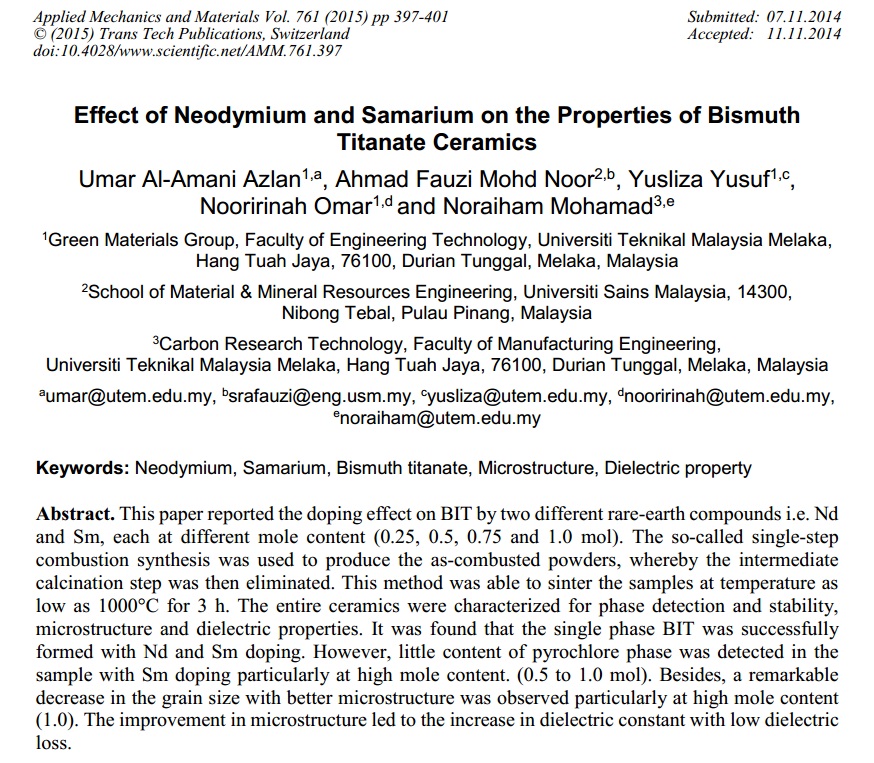
| Summary: | This paper reported the doping effect on BIT by two different rare-earth compounds i.e. Nd and Sm, each at different mole content (0.25, 0.5, 0.75 and 1.0 mol). The so-called single-step combustion synthesis was used to produce the as-combusted powders, whereby the intermediate calcination step was then eliminated. This method was able to sinter the samples at temperature as low as 1000°C for 3 h. The entire ceramics were characterized for phase detection and stability, microstructure and dielectric properties. It was found that the single phase BIT was successfully formed with Nd and Sm doping. However, little content of pyrochlorephase was detected in the sample with Sm doping particularly at high mole content. (0.5 to 1.0mol). Besides, a remarkable decrease in the grain size with better microstructure was observed particularly at high mole content (1.0). The improvement in microstructure led to the increase in dielectric constant with low dielectric loss. |
|---|