
Immobilization of Hepatitis B Antibody Onto the Reduced Graphene Oxide
Hepatitis B (Hep B) is a viral infection caused by hepatitis B virus (HBV) that infects the human liver. HBV is bloodborne and transfusion-transmitted human pathogen that has a large impact on blood safety and public health worldwide. Approximately 5% of the Malaysian population is infected by HBV....
Saved in:
| Main Authors: | , , |
|---|---|
| Format: | Article |
| Language: | en en en |
| Published: |
Penerbit Universiti Teknologi Malaysia
2015
|
| Subjects: | |
| Online Access: | http://umpir.ump.edu.my/id/eprint/6745/1/fkksa-2014-Geraldine-Immobilization_Of_Hepatitis_B.pdf http://umpir.ump.edu.my/id/eprint/6745/2/fkksa-2014-geraldine-posterbiojohor.JPG http://umpir.ump.edu.my/id/eprint/6745/8/fkksa-2015-geraldine-%20Immobilization%20of%20Hepatitis%20B%20Antibody.pdf http://umpir.ump.edu.my/id/eprint/6745/ https://doi.org/10.11113/jt.v77.6895 |
| Tags: |
Add Tag
No Tags, Be the first to tag this record!
|
| _version_ | 1831522031292645376 |
|---|---|
| author | Geraldine Chan, Sue Ching Willy Wong, Xiu Fa Chong, Fui Chin |
| author_facet | Geraldine Chan, Sue Ching Willy Wong, Xiu Fa Chong, Fui Chin |
| author_sort | Geraldine Chan, Sue Ching |
| building | UMPSA Library |
| collection | Institutional Repository |
| content_provider | Universiti Malaysia Pahang Al-Sultan Abdullah |
| content_source | UMPSA Institutional Repository |
| continent | Asia |
| country | Malaysia |
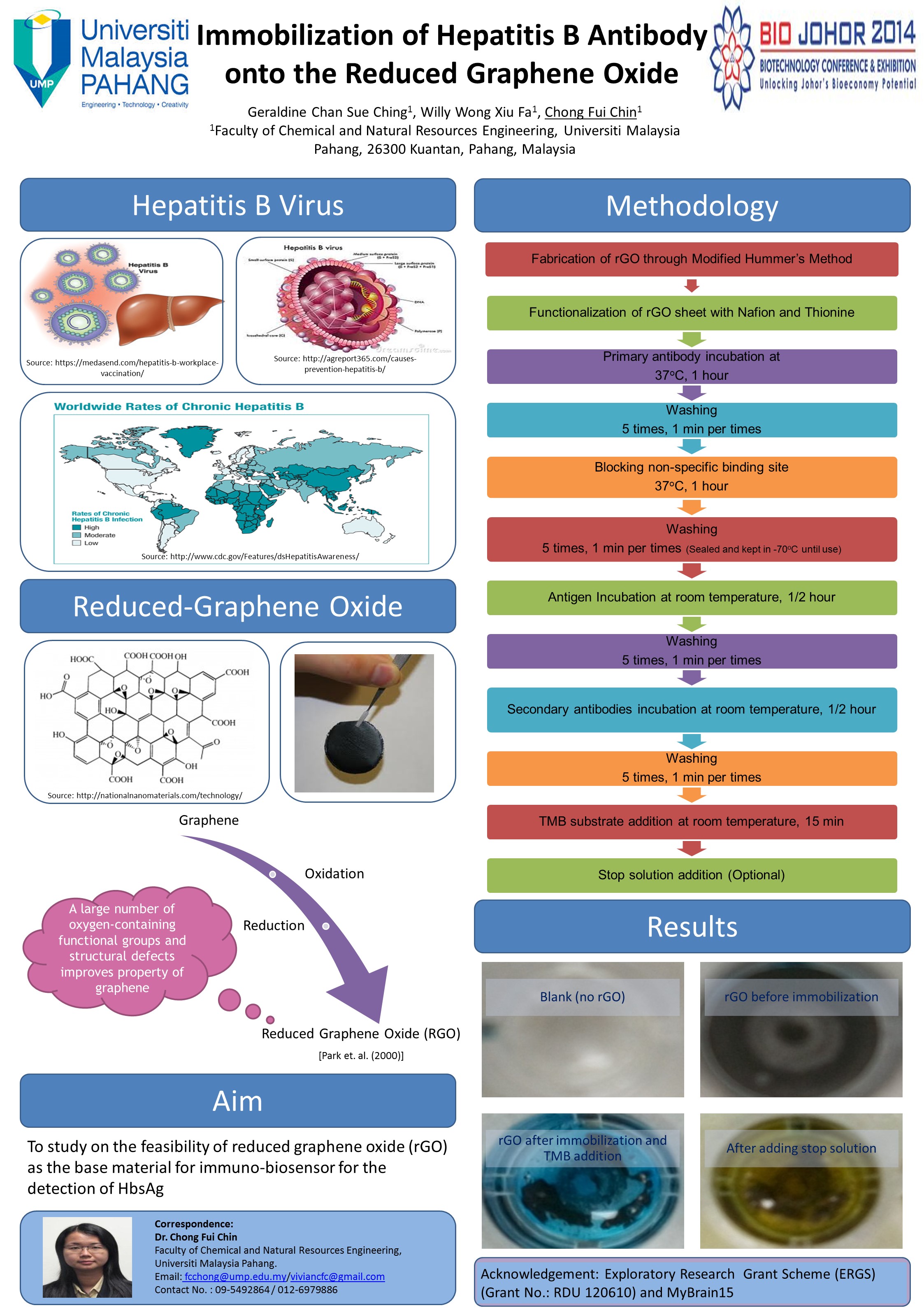
| description | Hepatitis B (Hep B) is a viral infection caused by hepatitis B virus (HBV) that infects the human liver. HBV is bloodborne and transfusion-transmitted human pathogen that has a large impact on blood safety and public health worldwide. Approximately 5% of the Malaysian population is infected by HBV. The treatment to this disease is possible if early detection is done before irreversible liver damage occurs. The presence of Hepatitis B virus surface antigen (HB5Ag) is an evidence of the presence of HBV infections. Presently, the conventional methods used for detection shows weakness in terms of time and efficiency. In this research, we aim to study on the feasibility of reduced graphene oxide (rGO) as the base material for immune biosensor for the detection of HB5Ag. The graphene oxide was prepared via Modified Hummer's Method due to its ability to produce graphene in large quantity. The fabrication of immunosensor was conducted by immobilizing antibody onto the graphene. Nafion-graphene nanosheet was grown and later treated with Thionine solution. Following that, a solution of primary antibodies against Hep B surface antigen (anti-HB5Ag lgG) was incubated on the biosensor. After the immobilization, the antigen was dropped onto the biosensor, followed by incubation of secondary antibodies conjugated to Horseradish Peroxidase (HRP). Upon addition of Tetramethylbenzid me (TMB), the colour of the solution changes to blue. |
| format | Article |
| id | my.ump.umpir.6745 |
| institution | Universiti Malaysia Pahang |
| language | en en en |
| publishDate | 2015 |
| publisher | Penerbit Universiti Teknologi Malaysia |
| record_format | eprints |
| spelling | my.ump.umpir.67452019-10-17T08:01:49Z http://umpir.ump.edu.my/id/eprint/6745/ Immobilization of Hepatitis B Antibody Onto the Reduced Graphene Oxide Geraldine Chan, Sue Ching Willy Wong, Xiu Fa Chong, Fui Chin TP Chemical technology Hepatitis B (Hep B) is a viral infection caused by hepatitis B virus (HBV) that infects the human liver. HBV is bloodborne and transfusion-transmitted human pathogen that has a large impact on blood safety and public health worldwide. Approximately 5% of the Malaysian population is infected by HBV. The treatment to this disease is possible if early detection is done before irreversible liver damage occurs. The presence of Hepatitis B virus surface antigen (HB5Ag) is an evidence of the presence of HBV infections. Presently, the conventional methods used for detection shows weakness in terms of time and efficiency. In this research, we aim to study on the feasibility of reduced graphene oxide (rGO) as the base material for immune biosensor for the detection of HB5Ag. The graphene oxide was prepared via Modified Hummer's Method due to its ability to produce graphene in large quantity. The fabrication of immunosensor was conducted by immobilizing antibody onto the graphene. Nafion-graphene nanosheet was grown and later treated with Thionine solution. Following that, a solution of primary antibodies against Hep B surface antigen (anti-HB5Ag lgG) was incubated on the biosensor. After the immobilization, the antigen was dropped onto the biosensor, followed by incubation of secondary antibodies conjugated to Horseradish Peroxidase (HRP). Upon addition of Tetramethylbenzid me (TMB), the colour of the solution changes to blue. Penerbit Universiti Teknologi Malaysia 2015 Article PeerReviewed pdf en http://umpir.ump.edu.my/id/eprint/6745/1/fkksa-2014-Geraldine-Immobilization_Of_Hepatitis_B.pdf pdf en http://umpir.ump.edu.my/id/eprint/6745/2/fkksa-2014-geraldine-posterbiojohor.JPG pdf en http://umpir.ump.edu.my/id/eprint/6745/8/fkksa-2015-geraldine-%20Immobilization%20of%20Hepatitis%20B%20Antibody.pdf Geraldine Chan, Sue Ching and Willy Wong, Xiu Fa and Chong, Fui Chin (2015) Immobilization of Hepatitis B Antibody Onto the Reduced Graphene Oxide. Jurnal Teknologi (Sciences and Engineering), 77 (31). pp. 25-29. ISSN 0127-9696 (print); 2180-3722 (online). (Published) https://doi.org/10.11113/jt.v77.6895 doi: 10.11113/jt.v77.6895 |
| spellingShingle | TP Chemical technology Geraldine Chan, Sue Ching Willy Wong, Xiu Fa Chong, Fui Chin Immobilization of Hepatitis B Antibody Onto the Reduced Graphene Oxide |
| title | Immobilization of Hepatitis B Antibody Onto the Reduced Graphene Oxide |
| title_full | Immobilization of Hepatitis B Antibody Onto the Reduced Graphene Oxide |
| title_fullStr | Immobilization of Hepatitis B Antibody Onto the Reduced Graphene Oxide |
| title_full_unstemmed | Immobilization of Hepatitis B Antibody Onto the Reduced Graphene Oxide |
| title_short | Immobilization of Hepatitis B Antibody Onto the Reduced Graphene Oxide |
| title_sort | immobilization of hepatitis b antibody onto the reduced graphene oxide |
| topic | TP Chemical technology |
| url | http://umpir.ump.edu.my/id/eprint/6745/1/fkksa-2014-Geraldine-Immobilization_Of_Hepatitis_B.pdf http://umpir.ump.edu.my/id/eprint/6745/2/fkksa-2014-geraldine-posterbiojohor.JPG http://umpir.ump.edu.my/id/eprint/6745/8/fkksa-2015-geraldine-%20Immobilization%20of%20Hepatitis%20B%20Antibody.pdf http://umpir.ump.edu.my/id/eprint/6745/ https://doi.org/10.11113/jt.v77.6895 |
| url_provider | http://umpir.ump.edu.my/ |